Some Facts about Canada's Population
Canada is the second largest country in the world — almost 10 million square kilometres or 3.8 million square miles – and composed of ten provinces and three territories.
- In 2016, the population was 35.1 million.
- There are three distinct groups of Indigenous peoples in Canada: First Nations, Métis, and Inuit. In 2016, they represented nearly 5 per cent of the population, or over 1.6 million.
- The population density is only about 3.9 people per square kilometre.
- The population is not spread evenly over the territory; two out of three Canadians live within 100 kilometres of the southern border with the United States.
- Approximately 83 per cent of the population lives in urban centres.
- 47 per cent of the population lives in just six metropolitan areas.
Statistics Canada maintains a wealth of data on Canada’s population.
Responsibility for Education
Responsibility
In the 10 provinces and 3 territories, departments or ministries of education are responsible for the organization, delivery, and assessment of education at the elementary and secondary levels, for technical and vocational education, and for postsecondary education. Some provinces and territories have separate departments or ministries: one having responsibility for elementary-secondary education and another for postsecondary education, adult learning, and skills training. As of June 2021, eight provinces and territories have placed early childhood learning and development under the umbrella of education.
Regional Differences
While there are a great many similarities in the provincial and territorial education systems across Canada, there are also significant differences in curriculum, assessment, and accountability policies among provinces and territories that express the geography, history, language, culture, and corresponding specialized needs of the populations served. The comprehensive, diversified, and widely accessible nature of the education systems in Canada reflects the societal belief in the importance of education.
Educational Funding
In 2018 –19, public and private expenditure on education amounted to $112.8 billion spent on all levels of education. Of this total:
- $78.5 billion was for elementary and secondary education
- $41.5 billion for postsecondary education
In 2017-18, combined public and private expenditure on education was $119.222 billion:
- $66.6 billion on elementary and secondary education
- $49.464 billion on postsecondary education ($18.780 billion on colleges and $30.684 billion on universities)
Structure of the Educational Systems
The following chart illustrates the structure of the educational system in each province and territory at the elementary, secondary, and postsecondary levels.
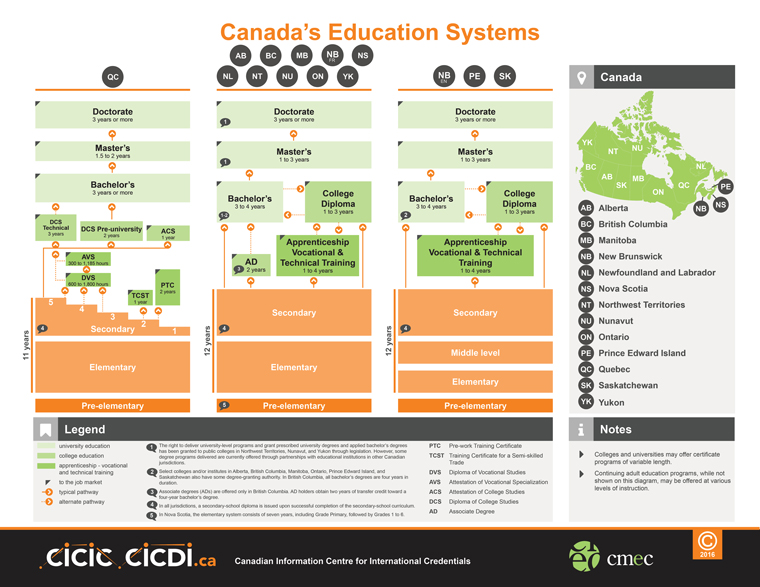
Click on graphic to display full sized printable copy. CICIC has a wealth of information about provincial and territorial education systems.
Elementary and Secondary Education
Government Role
Public education is provided free to all Canadians who meet various age and residence requirements. Each province and territory has one or two departments/ministries responsible for education, headed by a minister who is almost always an elected member of the legislature and appointed to the position by the government leader of the province or territory. Deputy ministers, who belong to the civil service, are responsible for the operation of the departments. The ministries and departments define both the education services provided and the policy and legislative frameworks for education. They also provide educational, administrative, financial management to support school functions.
Local Governance
Local governance of education is usually entrusted to school boards, school districts, school divisions, or district education councils. Their members are elected by public ballot. The power delegated to the local authorities is at the discretion of the provincial and territorial governments and generally consists of the operation and administration (including financial) of the group of schools within their board or division, curriculum implementation, responsibility for personnel, enrolment of students, and initiation of proposals for new construction or other major capital expenditures.
Schools and Enrolments
As of 2020, there are approximately 14,600 public schools in Canada:
- 10,100 elementary schools
- 2,600 secondary schools
- 2,100 mixed elementary and secondary schools
In 2018–19, provinces and territories reported that there were almost 5.7 million students enrolled in public elementary and secondary schools with an average of 390 students per school.
Minority-Language Education:
In Canada, the constitution recognizes French and English as its two official languages, though over 215 languages were reported as being spoken by Canadians in 2016, of which more than 70 are Indigenous languages. According to the 2016 Census, more than 86 per cent of French-mother-tongue Canadians live in the province of Quebec: the minority language rights of French-speaking students living outside the province of Quebec and English-speaking students living in the province of Quebec are protected in the Canadian Charter of Rights and Freedoms. The Charter defines the conditions under which Canadians have the right to access publicly funded education in either minority language. Each province and territory has established French-language school boards to manage the French-first-language schools. In the province of Quebec, the same structure applies to education in English-first-language schools.
Funding Sources
Public funding for education comes either directly from the provincial or territorial government or through a mix of provincial transfers and local taxes collected either by the local government or by the boards with taxing powers. Provincial and territorial regulations, revised yearly, provide the grant structure that sets the level of funding for each school board based on factors such as the number of students, special needs, and location.
Educators
In 2019, Canada's elementary and secondary school systems employed 766,200 educators, most of whom had four or five years of postsecondary study. These educators are primarily teachers, but principals, vice-principals, and professional non-teaching staff such as consultants and counselors are also included. Most secondary school teachers have a subject specialization in the courses they teach.
Early Childhood or Pre-Elementary Education
Every province and territory provides Kindergarten programs, whether full-day or half-day, mandatory or voluntary. Eight provinces and territories provide full-day Kindergarten for all five-year-olds. Kindergarten in Canada is considered part of the formal education system and has a dedicated curriculum in all 13 provinces and territories. While these programs are only compulsory in a few provinces, 97 per cent of children who are of eligible age attend Kindergarten in Canada.
Elementary Education
The ages for compulsory schooling vary among provinces and territories, but most require attendance in school from age 6 to age 16. In some cases, compulsory schooling starts at 5, and in others it extends to age 18 or graduation from secondary school. In most provinces and territories, elementary schools cover six to eight years of schooling. Almost 98 per cent of elementary students go on to the secondary level.
Curriculum in Elementary Education
The elementary school curriculum emphasizes the basic subjects of language, mathematics, social studies, science, health and physical education, and introductory arts; some provinces and territories include second-language learning. In many provinces and territories, increased attention is being paid to literacy, especially in the case of boys, as test results have shown that their performance is falling behind that of girls in language.
Secondary Education
Secondary school covers the final four to six years of compulsory education. The secondary school graduation rate in 2017 –18 was 81 per cent, with 84 per cent of females and 77 per cent of males graduating. The overall graduation rate has been steadily increasing while the longer-term dropout rate has declined as older students complete their secondary education. In 2017–18, the dropout rate (defined as 25- to 64-year-olds without an upper-secondary education) had fallen to 8 per cent.
Curriculum in Secondary Education
In the first years, students take mostly compulsory courses, with some options. The proportion of options increases in the later years so that students may take specialized courses to prepare for the job market or to meet the differing entrance requirements of postsecondary institutions. Secondary school diplomas are awarded to students who complete the requisite number of compulsory and optional courses. In most cases, vocational and academic programs are offered within the same secondary schools; in others, technical and vocational programs are offered in separate, dedicated vocational training centres. For students with an interest in a specific trade, programs varying in length from less than one year to three years are offered, many of them leading to diplomas and certificates.
Separate and Private Schools
The legislation and practices concerning the establishment of separate educational systems and private educational institutions vary among provinces and territories. Some provinces provide for tax-supported separate school systems that include both elementary and secondary education. These separate school systems reflect the constitutionally protected right to religious education for Roman Catholics or Protestants, when either group is the religious minority in a community. Public and separate school systems that are publicly funded serve about 93 per cent of all students in Canada.
Postsecondary Education
Range of Institutions
Postsecondary education is available in both government-supported and private institutions, which offer degrees, diplomas, certificates, and attestations depending on the nature of the institution and the length of the program. The postsecondary environment has evolved during the past few years, as universities are no longer the only degree-granting institutions in some provinces. A recognized postsecondary institution is a private or public institution that has been given full authority to grant degrees, diplomas, and other credentials by a public or private act of the provincial or territorial legislature or through a government-mandated quality assurance mechanism.
Number of Institutions
Canada has 223 public and private universities, and 213 public colleges and institutes. Consult the Directory of Educational Institutions in Canada for a complete list of institutions.
Funding
Statistics Canada has reported that postsecondary institution revenue in 2018–19 increased to $41.5 billion (in 2001 constant dollars):
- Government funding is the largest revenue source for postsecondary education institutions. 45.8 per cent of postsecondary funding comes from the government.
- Student fees accounted for 29.4 per cent of total postsecondary education revenue
- Bequests, donations, nongovernmental grants, sales of products and services, and investments brought in another 25 per cent
Tuition Fees
In 2020-21, tuition costs averaged $6,580 for Canadian undergraduate programs, with international student fees averaging about $32,000 annually. Education is also funded through the money that governments transfer to individual students through loans, grants, and education tax credits.
Attendance and Graduation Trends
Participation in postsecondary education has grown significantly in the past few years, whether measured by numbers of enrolments or by the proportion of the population in any given age group who are attending college or university. While women continue to make up the majority of students on both university and college campuses, they are still in the minority in the skilled trades.
University Attendance and Graduation
According to Universities Canada, in 2019, there were 1,090,000 full-time university students, as well as 266,000 part-time students. In 2018, Canadian universities awarded an estimated 197,830 bachelor's degrees, 65,706 master's degrees, and 7,923 doctoral degrees.
University Governance
Publicly funded universities are largely autonomous; they set their own admissions standards and degree requirements and have considerable flexibility in the management of their financial affairs and program offerings. Government intervention is generally limited to funding, fee structures, and the introduction of new programs. Most Canadian universities have a two-tiered system of governance that includes a board of governors and a senate. Boards are generally charged with overall financial and policy concerns. Academic senates are responsible for programs, courses, admission requirements, qualifications for degrees, and academic planning. Their decisions are subject to board approval. Students are often represented on both bodies, as are alumni and representatives from the community at large.
University Activities
The majority of degree-granting institutions in Canada focus on teaching and research. In 2014, Canadian universities performed $13 billion worth of research and development, which was about 40 per cent of the national total. Teaching is the other key function, whether at the small liberal arts universities that grant only undergraduate degrees or at the large, comprehensive institutions. Registration varies from about 2,000 students at some institutions to a full-time enrolment of over 62,000 at the University of Toronto, Canada's largest English-language university.
University Programs
There are more than 10,000 undergraduate and graduate degree programs offered in Canadian universities, as well as professional degree programs and certificates. Most institutions provide instruction in either English or French; others offer instruction in both official languages. In 2020, Canadian universities employed over 47,000 full-time faculty members.
University Degrees
Universities and colleges focus on degree programs but may also offer some diplomas and certificates, often in professional designations. University degrees are offered at three consecutive levels:
- Students enter at the bachelor's level after having successfully completed secondary school or the two-year collèges d'enseignement général et professionnel (cégep) program in Quebec. Most universities also have special entrance requirements and paths for mature students. Bachelor's degrees normally require three or four years of full-time study, depending on the province and whether the program is general or specialized.
- A master's degree typically requires two years of study after the bachelor's degree.
- For a doctoral degree, three to five years of additional study and research plus a dissertation are the normal requirements.
The Canadian Degree Qualifications Framework outlines the degree levels in more detail. In regulated professions, such as medicine, law, education, and social work, an internship is generally required in order to obtain a licence to practise.
Attendance and Graduation at Colleges and Institutes
Statistics Canada has reported that, in 2018–19, college and institute enrolment was at an all-time high, with over 795,000 students enrolled. Just over 246,000 students graduated from Canadian colleges and institutes in 2017–18.
Governance in Colleges and Institutes
In publicly-funded colleges and institutes, government involvement can extend to admissions policies, program approval, curricula, institutional planning, and working conditions. Most colleges have boards of governors appointed by the provincial or territorial government, with representation from the public, students, and instructors. Program planning incorporates input from business, industry, and labour representatives on college advisory committees.
College Activities
There are thousands of public and private colleges and institutes in Canada. Of these, over 150 are recognized public colleges and institutes. These educational institutions may be called public colleges, specialized institutes, community colleges, institutes of technology, colleges of applied arts and technology, or cégeps. The private colleges are most often called career colleges.
College Programs
Colleges and institutes offer a range of vocation-oriented programs in a wide variety of professional and technical fields, including business, health, applied arts, technology, and social services. Some of the institutions are specialized and provide training in a single field such as fisheries, arts, paramedical technology, and agriculture. Colleges also provide literacy and academic upgrading programs, pre-employment and pre-apprenticeship programs, and the in-class portions of registered apprenticeship programs. As well, many different workshops, short programs, and upgrades for skilled workers and professionals are made available.
College Credentials
Diplomas are generally awarded for successful completion of two- and three-year college and institute programs, while certificate programs usually take up to one year. University degrees and applied degrees are offered in some colleges and institutes, and others provide university transfer programs. Les cégeps in Quebec offer a choice of two-year academic programs that are prerequisite for university study or three-year technical programs that prepare students for the labour market or for further postsecondary study.
Colleges in their Communities
Colleges work very closely with business, industry, labour, and the public service sectors in the provision of professional development services and specialized programs and, on a wider basis, with their communities to design programs reflecting local needs.
Prior Learning Assessment and Recognition
About 80 per cent of colleges also recognize prior learning assessment and recognition (PLAR) in at least some of their programs. Some universities also recognize it, and a growing number of provinces offer PLAR to adults at the secondary school level. PLAR is a process that helps adults demonstrate and gain recognition for learning they have acquired outside of formal education settings.
Vocational Education and Training
Public Providers
Vocational education refers to a multi-year program or a series of courses providing specialized instruction in a skill or a trade intending to lead the student directly into a career or program based on that skill or trade. It is offered in secondary schools and at the postsecondary level in public colleges and institutes, private for-profit colleges, and in the workplace, through apprenticeship programs. At the secondary level, vocational programs may be offered at separate, specialized schools or as optional programs in schools offering both academic and vocational streams. The secondary school programs prepare the student for the workforce, a postsecondary program, or an apprenticeship. The role of public colleges has been described above.
Private Providers
Private colleges may be licensed by provincial governments or may operate as unlicensed entities. They may receive some public funding but are largely funded through tuition fees and offer programs in such areas as business, health sciences, human services, applied arts, information technology, electronics, services, and trades. Programs usually require one or two years of study, although some private career colleges offer programs of shorter duration.
Apprenticeship
Apprenticeship programs in Canada have been generally geared toward adults, with youth becoming increasingly involved in some provinces and territories. The related industry is responsible for practical training delivered in the workplace, and the educational institution provides the theoretical components. Apprenticeship registrations have shown a decrease in recent years, from over 455,000 in 2015, to almost 400,000 in 2019. The largest trade group is electricians, with over 68,000 registrations.
Adult Education and Skills Training
Many institutions, governments, and groups are involved in the delivery of adult education and skills training programs, with the providers varying among provinces and territories.
- Colleges offer adult education and skills training for the labour force; government departments responsible for literacy, skills training, second-language learning, and other adult programs may provide programs themselves or fund both formal and non-formal educational bodies to develop and deliver the programs.
- Some provinces and territories have established dedicated adult learning centres.
- Community-based, not-for-profit, and voluntary organizations, school boards, and some private companies, largely funded by the provincial, territorial, or federal governments, address literacy and other learning needs for all adults, with some of them focusing on specific groups such as rural populations, the Indigenous communities, immigrants, displaced workers, and those with low levels of literacy or education.
- The federal government works with the provincial and territorial governments to fund many of the skills training and English and French second-language programs.
The Programme for the International Assessment of Adult Competencies (PIAAC), 2012, revealed that Canadians were among the most equipped with the new skills demanded in the 21st century, as they have high levels of proficiency in literacy, numeracy, and problem solving in technology-rich environments. In fact, Canada had one of the most skilled and educated labour forces in the OECD. However, several sub-groups of the population had disproportionately low levels of proficiency in the three domains assessed, most notably individuals who had not completed high school, immigrants, and Indigenous people.
Indigenous education
Indigenous Education at the Elementary and Secondary Levels
The federal government shares responsibility with First Nations for the provision of education to children ordinarily residing on reserve and attending provincial, federal, or band-operated schools. In fiscal year 2016 to 2017, the Government of Canada invested $1.94 billion in First Nations elementary and secondary education programs. In April 2019, Indigenous Services Canada implemented a new co-developed approach to better meet the needs of First Nations students on reserve and improve outcomes. Band-operated schools located on reserves educate approximately 64 per cent of the students living on reserves, while 36 per cent go off reserve to schools under provincial authority, usually for secondary school. First Nations children living off reserve as well as Métis and Inuit children are educated in the public elementary and secondary schools in their cities, towns, and communities, with the provinces and territories providing the majority of educational services for Indigenous students.
First Nations, Métis, and Inuit students pursuing a postsecondary education attend both government-supported and private institutions for a wide range of programs. Additionally, there are several Indigenous postsecondary institutions as well as Indigenous-led faculties within non-Indigenous establishments across Canada which offer specialized and culturally relevant programming ranging from trade skills training to doctorates. Indigenous postsecondary institutions play many roles in the postsecondary sector, notably in providing access to learners who might otherwise not participate in postsecondary education or training. Indigenous students have access to targeted financial support provided by the institutions they attend as well as by provincial and territorial postsecondary strategies.
Between 2017 and 2019, Indigenous Services Canada conducted a comprehensive and collaborative review of all current federal programs that support Indigenous students who wish to pursue postsecondary education. Budget 2019 invested $814.9 million over 10 years and $61.8 million ongoing for distinctions-based Indigenous postsecondary education strategies. This funding will renew and expand the Post-Secondary Student Support Program (which provides financial support to eligible Status First Nations postsecondary students), establish new Inuit and Métis Nation postsecondary education strategies, and engage with First Nations to develop regional postsecondary strategies. The department also provides support to First Nations established postsecondary education institutions and First Nations-directed community-based programming through its Post-Secondary Partnerships Program.
Indigenous-languages education
There are more than 70 Indigenous languages currently spoken in Canada across 12 language groups: Algonquian languages, Inuit languages, Athabaskan languages, Siouan languages, Salish languages, Tsimshian languages, Wakashan languages, Iroquoian languages, Michif, Tlingit, Kutenai and Haida. In 2016, an estimated 260,550 people were speaking their Indigenous language. Colonial policies have significantly harmed the vitality of Indigenous languages in Canada and several are now “endangered,” with few speakers, although a few others are considered “viable” in the long term. Six of the Truth and Reconciliation Commission’s 94 calls to action are specific to language and culture. In response, provinces and territories have developed curriculum and teaching resources for Indigenous languages education. The province of Manitoba and the three territories of Nunavut, Yukon, and the Northwest Territories have also implemented legislation that formally recognize Indigenous languages in their respective regions.
At the Canada-level, the federal government is also engaged in supporting Indigenous languages. In 2019, the federal government passed the Indigenous Languages Act, which is intended to support the reclamation, revitalization, maintaining and strengthening of Indigenous languages in Canada. The act established the Office of the Commissioner of Indigenous Languages, whose mandate notably includes supporting innovative projects and the use of new technologies in Indigenous language education and revitalization. Additionally, the federal government financially supports Indigenous languages education, for instance by providing funding to Indigenous organizations through its Indigenous Languages and Cultures Program.
Activities of the Government of Canada
The Federal Contribution
The federal government of Canada provides financial support for postsecondary education and the teaching of the two official languages. In addition, the federal government is responsible for the education of Indigenous Canadians on reserve, personnel in the armed forces and the coast guard, and inmates in federal correctional facilities.
Federal Funding Support for Postsecondary Education
In addition to providing revenue for universities and colleges through transfer payments, the federal government offers direct student support. These programs, and many similar ones offered by the provinces and territories, are designed to make postsecondary education more widely accessible and to reduce student debt:
- Every year, the Canada Millennium Scholarship Foundation awards $350 million in bursaries and scholarships each year to about 100,000 students throughout Canada, providing income-based grants to postsecondary students.
- For parents, the Canada Education Savings Grant program supplements their savings for postsecondary education.
Official Languages
Reflecting its history and culture, Canada adopted the Official Languages Act, first passed in 1969 and revised in 1988, which established both French and English as the official languages of Canada and provided for the support of English and French minority populations. According to the 2016 Census, 68.3 per cent of the population speak English only, 11.9 per cent speak French only, and 17.9 per cent speak both French and English. The French-speaking population is concentrated in Quebec, while each of the other provinces and territories has a French-speaking minority population; Quebec has an English-speaking minority population.
Language Education
The federal government's official-language policy and funding programs include making contributions to two education-related components — minority-language education and second-language education. Through the Official Languages in Education Program, the federal government transfers funding for these activities to the provinces and territories based on bilateral and general agreements that respect areas of responsibility and the unique needs of each province and territory. The bilateral agreements related to these contributions are negotiated under a protocol worked out through the Council of Ministers of Education, Canada (CMEC). Three pan-Canadian federally funded programs (Explore, Destination Clic, and Odyssey), coordinated by CMEC, provide youth with opportunities for exchange and summer study to enhance their first language and second-language skills (more information available on the promotional site: www.EnglishFrench.ca).
The Council of Ministers of Education, Canada
The Council of Ministers of Education, Canada (CMEC) was formed in 1967 by the provincial and territorial ministers responsible for education to provide a forum in which they could discuss matters of mutual interest, undertake educational initiatives cooperatively, and represent the interests of the provinces and territories with national educational organizations, the federal government, foreign governments, and international organizations. CMEC is a collective voice for education in Canada and, through CMEC, the provinces and territories work together on common objectives in a broad range of activities at the elementary, secondary, and postsecondary levels.